

Policy Research
KOSTI provides expert information required by Korean corporations with research on domestic and foreign trade security policies.
KOSTI continuously monitors domestic and global trade security policy trends, analyzes and communicates information needed by Korean companies, encourages academic interest and research, and supports government policy making.
Amid increasing risks such as export controls and the stronger controls on advanced technologies, KOSTI has worked to provide the information Korean companies need. It monitors trade security trends in real time and responds to companies’ information needs by publishing specialized reports, by category, including Trade Security 24 for breaking updates, Issue Analysis Reports for analysis of current trade security issues, Overseas Research Trend Reports summarizing major overseas reports, and Trade Security Briefs for in-depth analysis of specific topics.
Trends research
KOSTI monitors the latest trends in the field of trade security, and shares the results of its analysis on implications.
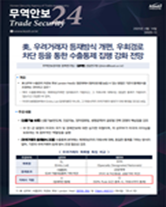
Trade Security 24
A rapid-alert summary report setting out trade security measures taken by major countries as they happen.
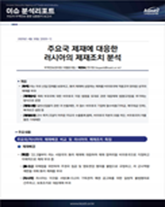
Issue Analysis Report
An analytical report that examines key domestic and international trade security issues and draws out their policy implications.
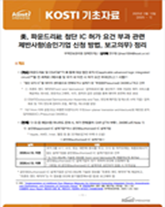
KOSTI Basic Materials
Background information on major issues
Overseas Research Trends Report
Summaries of trade security reports published by leading overseas research institutions
Policy Analysis and Research
KOSTI publishes research reports analyzing trade security systems and trends in major countries, sanctioned items, institutional changes, and future prospects.
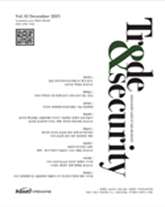
Trade&Security
A specialist journal on economic security, carrying the views of Korean and international experts on key issues such as export controls, sanctions and investment security.
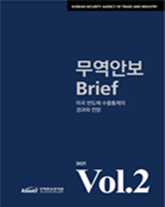
Trade Security Brief
In-depth studies of international outlooks, policies and legislation.
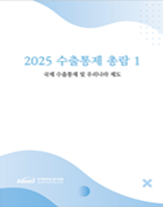
Export Control Compendium
Comparative research reports organized by topic and by country.
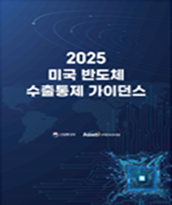
U.S. Export Control Guidance
A practical guide for compliance practitioners.
Revitalizing domestic trade security research and networks
KOSTI is expanding the research base by building a network that connects experts from domestic related institutions and universities. It has created an environment for experts to maintain an ongoing interest in trade security, a global issue, and to pursue in-depth research and exchange, while working to provide the government and industry with high-quality information.
KOSTI selected research topics based on trade security trends, government policies and public demand surveys, and conducted specialized research reports tailored to policy stakeholders’ needs through relevant experts. It also strengthened its internal research expertise by serving as the corresponding author for each research report.
Overview of Korea’s Export Control System
What are strategic items?
Strategic items are goods, software and technology that can be used in the manufacture, development, use or storage of conventional weapons or weapons of mass destruction (WMD), or of the missiles that deliver them.
Control of strategic items
In line with the international export control regimes and equivalent multilateral arrangements, Korea imposes restrictions such as export licensing in order to maintain international peace and security and to safeguard national security.
Regulations
Matters relating to export management — including export licensing and the classification of strategic items — are governed by the Foreign Trade Act, the Enforcement Decree of the Foreign Trade Act, and the Public Notice on Trade in Strategic Items.


Competent Authorities and Supporting Institutions by Item Category
| Item category | Legal basis | Competent authority | Supporting institution |
|---|---|---|---|
| Dual-use items | Foreign Trade Act | Ministry of Trade, Industry and Resources (MOTIR) | KOSTI |
| Military items and defense materiel | Defense Acquisition Program Act | Defense Acquisition Program Administration (DAPA) | Defense Agency for Technology and Quality (DTaQ) |
| Dedicated nuclear items | Nuclear Safety Act | Nuclear Safety and Security Commission (NSSC) | Korea Institute of Nuclear Nonproliferation and Control (KINAC) |
Licensing
Exports of strategic items, strategic technology and items subject to situational (catch-all) licensing require prior government approval. Where a classification finds that the item to be exported is a strategic item, or that it meets the conditions for situational licensing, prior government approval is required.
Types of licenses
| License | Description |
|---|---|
| Individual export license | The standard license covering a specific export transaction. |
| Comprehensive export license (end-user based / item based) | Available to companies designated as Compliance Program (CP) traders. |
| Situational (catch-all) license | Required even for non-strategic items where (i) there is a concern that the item may be diverted to WMD use, (ii) the export involves a designated country or item, (iii) red flags arise in the transaction, or (iv) the export is destined for a party listed on an international list of entities of concern. |
| Transit and transshipment license | Required where strategic items or items subject to situational licensing pass through a Korean port or airport, or are transshipped within Korea. |
| Brokering license | Required where a Korean national (including a corporation) or a foreign national residing in Korea intends to broker the export of a strategic item or of an item requiring a situational license. |
Penalties for Unlicensed Export
Exporting strategic items and similar goods without a license is subject to criminal punishment and administrative sanctions under the Foreign Trade Act.
Administrative sanctions (Articles 30 and 49 of the Foreign Trade Act)
- Restriction on the export and import of strategic items for up to three years
- An order to complete up to eight hours of compliance education
Criminal punishment (Article 53 and related provisions of the Foreign Trade Act)
- Imprisonment for up to seven years
- A fine of up to five times the value of the goods concerned
Compliance Program (CP)
The companies, universities and research institutes that have put an internal compliance system* in place and operate their procedures in accordance with the relevant laws are designated by the Minister of Trade, Industry and Resources following a review that takes account of their sector, their size and the grade applied for.
*Internal compliance system: establishing and operating a framework for voluntarily complying with export control laws and regulations in all matters relating to a transaction, including verifying whether an item is a strategic item and confirming the end use and the end user.
Compliance Program (CP) traders are companies that responsibly implement strategic item export controls based on their own internal management systems and are eligible for various government benefits such as comprehensive licenses.
MOTIR (Ministry of Trade, Industry and Resources) designates a company with internal export management compliance procedures as a CP trader based on its assessment.
KOSTI organizes workshops to help CP companies respond effectively to the latest regulatory changes and trade security trends, strengthen their practical capabilities, and support the sharing of best practices and the building of networks among companies.
Benefits of CP
- Substantially simplified export licensing procedures
Document submission and review requirements for individual export license applications are waived to varying degrees according to the CP grade.
AA and AAA grade holders become eligible to apply for comprehensive export licenses, which cover multiple transactions at once.
- Reduced post-transaction reporting burden
The deadline for submitting post-transaction reports arising from license exemptions is eased to semi-annual or annual filing, depending on the grade.
Application and Designation Procedure
| Party | Procedure |
|---|---|
| Company | Prepare the application documents → apply for a grade designation → (supplement the documents if requested) |
| KOSTI | Review the application documents → form an evaluation committee → notify the review schedule → conduct the document review and the on-site review → notify the results → deliver the final evaluation report |
| MOTIR | Receive the evaluation report → convene the deliberation committee → decide whether to grant designation → notify the result |
| Company | Confirm the detailed on-site review schedule → receive and respond to any requests for supplementary information → designation |